Research modelers interested in fish, wildlife, and decisions
University of Idaho · Department of Fish and Wildlife Sciences · USGS Idaho Cooperative Fish and Wildlife Research Unit
Research
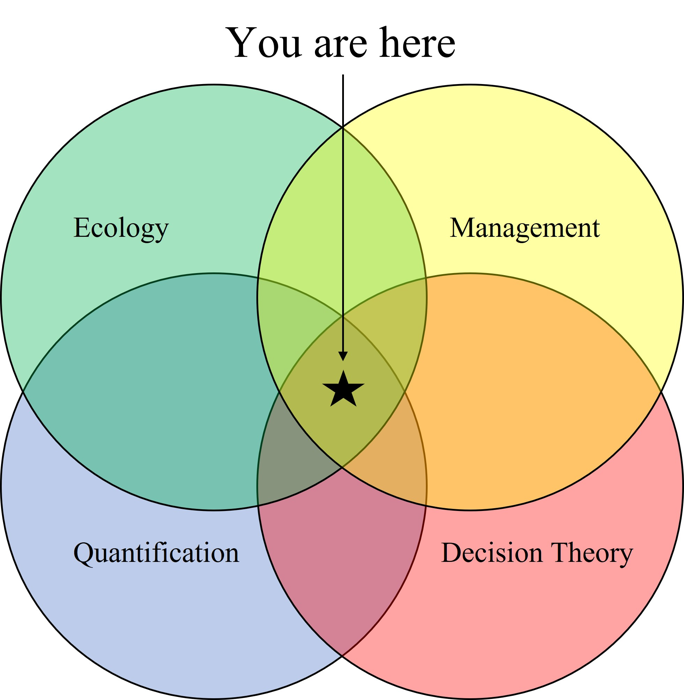
We bring rigorous, principled science to difficult ecological management problems. Management problems are uncertainty problems, so we focus on modeling what is known, and what isn’t, about the systems we study.
We are applied ecologists. We work on species with existing management needs, and management professionals are partners in every project. They bring knowledge of each species’ life history and the social context that shapes management actions.
We also use and develop decision theory. Our tools range from Bayesian belief networks that capture complex decisions to calculations of the value of new information. Decision theory helps make our applied ecology applied.
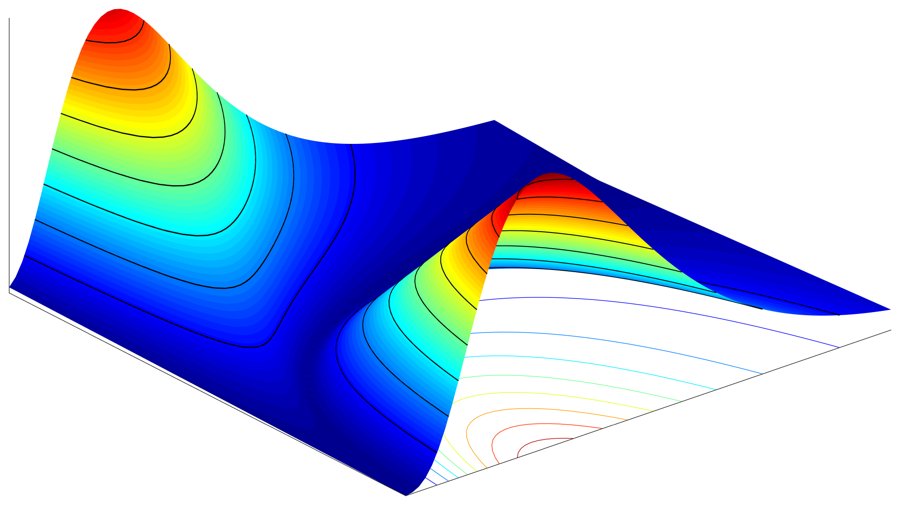
Research on a harvested population is usually prioritized by what is most uncertain about the ecology. Adding managers’ objectives and society’s values through the expected value of perfect information changes which uncertainties matter, and the answer depends on the utility function used to represent risk and reward.
Falcy, M.R. 2021. Using social values in the prioritization of research: Quantitative examples and generalizations. Ecology and Evolution 11:18000–18010. PDF
Explained in Falcy (2021).
When is new information worth what it costs?
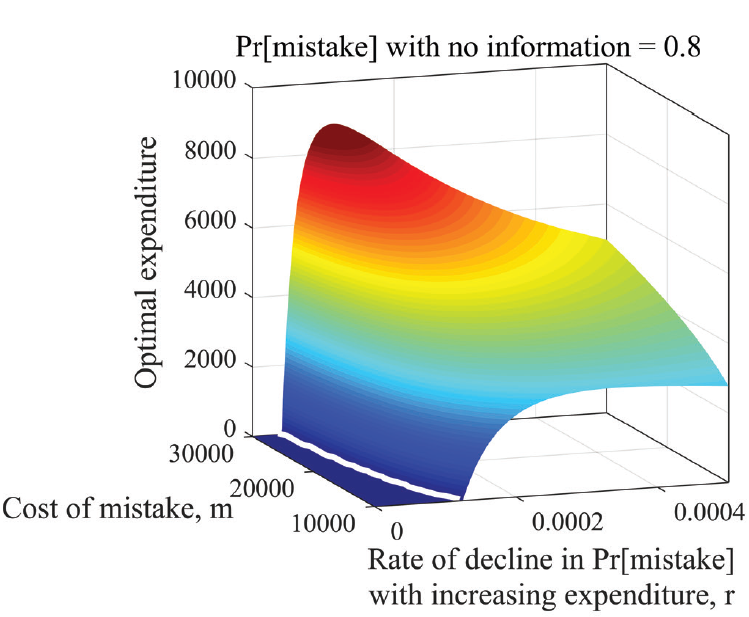
Monitoring and research are expensive, and more data is not always a better decision. Value-of-information analysis shows when the cost of learning exceeds the reduction in the chance of a bad decision, so applied science can be planned as an optimization problem.
Falcy, M.R. 2018. A cost-optimization framework for planning applied environmental science. BioScience 68:912–922. PDF
Explained in Falcy (2018).
How much precaution is enough?
“Better safe than sorry” is not a decision rule. I pair Bayesian estimates of uncertainty with an explicit mathematical form of the precautionary principle, so conservation decisions become transparent and replicable. The right level of precaution is a societal value, not a statistical result.
Falcy, M.R. 2016. Conservation decision making: Integrating the precautionary principle with uncertainty. Frontiers in Ecology and the Environment 14:499–504. PDF
Salmon, hatcheries, and monitoring
Does the standard index of hatchery risk match the theory behind it?
Managers index genetic risk from hatchery domestication with pHOS, the proportion of hatchery-origin spawners. The usual calculation overestimates risk when hatchery- and natural-origin fish spawn in different places or at different times. I derive a version that is consistent with the genetic model, along with its variance.
Falcy, M.R. 2026. Refining indices of risk from salmonid hatcheries. North American Journal of Fisheries Management 46:1–8. PDF
How many fish does a snorkeler miss?
We calibrated snorkel counts against mark-recapture estimates in 113 location-years of Oregon coastal streams. Snorkelers saw 63% of juvenile coho salmon, 47% of steelhead, and 39% of cutthroat trout, with high uncertainty. We give explicit expressions that convert a new snorkel count into a probability distribution of abundance, including habitat too shallow to snorkel.
Falcy, M.R., and R.J. Constable Jr. 2024. Quantifying uncertainty when extrapolating the relationship between snorkel counts and mark-recapture estimates of juvenile salmonids. Canadian Journal of Fisheries and Aquatic Sciences 81:1279–1291. PDF
Did management or the ocean rebuild Oregon coast coho?
We fit hierarchical state-space spawner-to-smolt models to 46 years of data from 18 populations. Freshwater productivity showed more evidence of decline than increase, so better ocean conditions most likely explain the recent rise in adults. Hatchery-origin spawners had about half the reproductive success of natural-origin spawners (0.51; 95% credible interval 0.19–0.89).
Falcy, M.R., and E. Suring. 2018. Detecting the effects of management regime shifts in dynamic environments using multi-population state-space models. Biological Conservation 221:34–43. PDF
How do salmon choose where to spawn as their numbers change?
Twenty-six years of spawning surveys along the Oregon coast show that the spatial distribution of Chinook salmon shifts with population size. The pattern fits a despotic distribution, where dominant or early-arriving fish exclude others from the best sites, rather than an ideal free distribution.
Falcy, M.R. 2015. Density-dependent habitat selection of spawning Chinook salmon: broad-scale evidence and implications. Journal of Animal Ecology 84:545–553. PDF
Viability, behavior, and landscapes
How do hurricanes and habitat loss combine to threaten an endangered mouse?
Patch occupancy of the Alabama beach mouse rose from 0.16 to 0.67 within three summers after hurricanes Ivan and Katrina. A spatially explicit viability analysis shows that extinction risk rises nonlinearly with habitat loss and hurricane frequency, and back-to-back hurricanes are especially dangerous.
Falcy, M.R., and B.J. Danielson. 2014. Post-hurricane recovery and long-term viability of the Alabama beach mouse. Biological Conservation 178:28–36. PDF
Can temperature reverse the effect of moonlight on a foraging mouse?
Yes. When it is warm, the predator ensemble shifts from mammals and birds that see better than the mouse to ectotherms that see worse. Giving-up densities of Alabama beach mice show the effect of moonlight on foraging reversing with temperature.
Falcy, M.R., and B.J. Danielson. 2013. A complex relationship between moonlight and temperature on the foraging behavior of the Alabama beach mouse. Ecology 94:2632–2637. PDF
Do cotton rats limit where beach mice can live?
After we removed hispid cotton rats, beach mice used the vacated habitat somewhat more, which fits a niche-constriction hypothesis. The evidence is weak, but removing cotton rats from habitat remnants right after a hurricane may lower extinction risk.
Falcy, M.R., and B.J. Danielson. 2013. Assessment of competitive release of endangered beach mouse (Peromyscus polionotus ammobates). Journal of Mammalogy 94:584–590. PDF
Can a sink rescue a source?
When disturbance periodically wrecks a source patch, the metapopulation can depend on a nearby sink to recolonize it. In a two-patch model, slowing the decline in the sink did more for persistence than speeding recovery in the source, and the effect grew with disturbance frequency.
Falcy, M.R., and B.J. Danielson. 2011. When sinks rescue sources in dynamic environments. In J. Liu, V. Hull, A.T. Morzillo, and J.A. Wiens, editors. Sources, Sinks and Sustainability. Cambridge University Press. PDF
People
Principal investigator
Matt Falcy
Associate Professor of Biometrics, University of Idaho Assistant Unit Leader, USGS Idaho Cooperative Fish and Wildlife Research Unit
My team and I develop quantitative tools for difficult ecological problems. We use math, statistics, and numerical simulation to model fish and wildlife management systems. Before coming to Idaho in 2021, I spent more than a decade as a quantitative fish biologist with the Oregon Department of Fish and Wildlife.
Builds population viability models for white sturgeon to inform management decisions.
Jacob Russell
PhD student · co-advised with Tim Link
Links hydrological models of snowpack and subterranean conditions to pygmy rabbit behavior and fitness through dynamic state variable models, and explores the fitness consequences of climate change.
Manuel (Manu) Carballo
MS student
Models selenium concentrations in the Kootenai River and their effects on burbot and white sturgeon. He combines spatio-temporal models with laboratory experiments on juvenile burbot survival.
Nate Nadal
MS student
Analyzes mountain whitefish diets in the Kootenai River. He uses simulation to test statistical procedures for detecting diet change after nutrient addition, drawing on stomach contents from about 2,000 fish.
Alumni
Sarah BassingPostdocAssistant Professor, Montana State University
Sam FosterPhDEcosystems Biologist, BC Ministry of Water, Land and Resource Stewardship
Joshua HeishmanMSFisheries Stock Assessment Biologist, Upper Skagit Indian Tribe
Ryan VosbigianMS and post-MSBiometrician, Quinault Indian Nation
Briana LubenauMS, co-advisedBiologist, U.S. Fish and Wildlife Service
Recent lab publications
As of September 25, 2026. * lab member.
2026
Vosbigian*, R., J.H. Powell, and M.R. Falcy. Integrating data on a mixed stock anadromous fishery to estimate stock-specific escapement and mortalities. North American Journal of Fisheries Management 46:447–462.
Falcy, M.R. Refining indices of risk from salmonid hatcheries. North American Journal of Fisheries Management 46:1–8.
2025
Bassing*, S.B., D.E. Ausband, M.A. Mumma, S. Thompson, M.A. Hurley, and M.R. Falcy. Mammalian predator co-occurrence affected by prey and habitat more than competitor presence at multiple time scales. Ecological Monographs 95:e164.
Vosbigian*, R., A. Ballinger, T.E. Link, T. Copeland, and M.R. Falcy. Elevation mediates juvenile steelhead demographic response to stream temperature and flow. Canadian Journal of Fisheries and Aquatic Sciences 82:1–16.
Harrison, L.A., K.S. Christie, C. Brandt, M.R. Falcy, R.A. Long, S.L. Gilbert, and J.L. Rachlow. Mechanism influencing thermal refuges and territory occupancy by pikas during summer and winter. Arctic, Antarctic, and Alpine Research 57:2502161.
2024
Vosbigian*, R., L. Wendling*, T. Copeland, and M.R. Falcy. Cycles in adult steelhead length suggest interspecific competition in the North Pacific Ocean. Canadian Journal of Fisheries and Aquatic Sciences 81:1666–1675.
Falcy, M.R., and R.J. Constable Jr. Quantifying uncertainty when extrapolating the relationship between snorkel counts and mark-recapture estimates of juvenile salmonids. Canadian Journal of Fisheries and Aquatic Sciences 81:1279–1291.
In review and in preparation
As of September 25, 2026. * lab member.
In review
Russell*, J., R.A. Vosbigian*, and M.R. Falcy. Misinformed by non-informative priors: Jeffreys’ method ensures consistent Bayesian inference. Ecology.
Falcy, M.R. Data-driven decision-making with novel probability density functions. Methods in Ecology and Evolution.
Falcy, M.R., and C.M. Lorion. Decision-making processes. In Inland Fisheries Management in North America, 4th edition.
Heishman*, J., A. Black, S. Wilson, and M.R. Falcy. An open-population demographic analysis of burbot in the Kootenai River to inform fishery management. Transactions of the American Fisheries Society.
Mumma, M., E. Roche, Z. Fogel, J. Tebbenkamp, J. Struthers, M. Parsons, K. Oelrich, M. Campbell, M.R. Falcy, and S. Roberts. Estimating gray wolf (Canis lupus) abundance using close-kin data and approximate Bayesian computation. Ecological Applications.
In revision
Sabal, M.C., E. Leonetti, M.R. Falcy, P. Stevens, J. Anthony, and C. Lorion. Forecasting spring Chinook salmon abundances amid a changing climate on the Umpqua River, Oregon. Canadian Journal of Fisheries and Aquatic Sciences.
Bassing*, S.B., D.E. Ausband, M.A. Mumma, J. Baumgardt, S. Thompson, M. Hurley, and M.R. Falcy. Disentangling the web of species interactions in a multi-predator, multi-prey community. Ecology.
In preparation
Vosbigian*, R.A., M. Dobos, and M.R. Falcy. An age- and time-specific space-for-time mark-recapture model.
Vosbigian*, R., D.W. Whitney, J.M. DuPont, and M.R. Falcy. Evaluating the influence of bag and size limits on harvest of steelhead.
Heishman*, J., S. Wilson, A. Black, N. Jensen, and M.R. Falcy. Beyond put and take: A quantitative framework for population-level decision-making.
Farris*, T., R.A. Vosbigian*, T. Copeland, M. Dobos, and M.R. Falcy. Snake River steelhead ocean survival driven by early ocean conditions and smolt size.
Ash*, J., C. Caudill, and M.R. Falcy. The evolution of philopatry on spatially structured and temporally trending landscapes.
Foster*, S., A. Ford, and M.R. Falcy. Caught in a time trap: Animal activity in the Anthropocene.
Foster*, S., A. Ford, and M.R. Falcy. Community reordering along disturbance gradients: Roads filter mammal composition.
Foster*, S., A. Ford, and M.R. Falcy. Seasonal and bottom-up processes drive weekly habitat use of mule deer more than perceived predation risks.
Macias*, C.L., M.R. Falcy, B.C. Augustine, J.R. Adams, S. Cendejas-Zarelli, S.H. Williams, L.M. Elbroch, K.A. Sager-Fradkin, and L.P. Waits. Evaluating new abundance estimators in real-world applications: Cameras and DNA yield comparable density estimates for cryptic carnivores in western Washington State.
Macias*, C.L., M.R. Falcy, T. Levi, L.M. Elbroch, K.A. Sager-Fradkin, and L.P. Waits. Prey composition and dietary overlap of bobcats and cougars using GPS collar data and DNA metabarcoding in western Washington State.
Macias*, C.L., M.R. Falcy, J.R. Adams, L.M. Elbroch, K.A. Sager-Fradkin, and L.P. Waits. Evaluating fecal DNA preservation and extraction methods for noninvasive wildlife genetic sampling.
Harrison, L.A., K.S. Christie, J.L. Rachlow, and M.R. Falcy. Pika behavioral response to climate during the summer foraging season at high latitudes.
Graduate school is a serious commitment, often more than 40 hours a week. It takes optimism, curiosity, and integrity. Our research is applied, so it depends on good working relationships with the agency professionals who support it, and every deliverable must meet professional standards and deadlines.
Students work from the University of Idaho graduate office during business hours and coordinate any absences with me. I treat graduate students as research partners and encourage each of them to build their own scientific worldview through broad and deep reading, coding, and discussion.
Interested? Watch the job board for posted positions. If you have a question about a posted opening, email me at mfalcy@uidaho.edu with a short note on your background and interests.